25 Tips on what to do before going Offroad
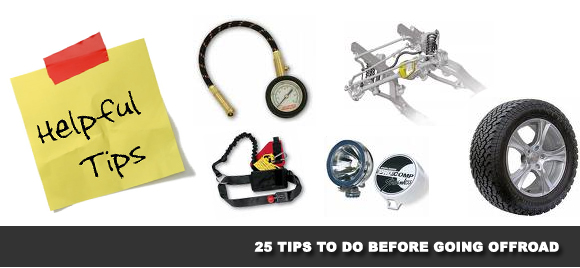
25 Tips for your 4x4 Driving Experience
- Check the Basics - Check all your fluids -coolant, oil, windshield washer fluid, power steering fluid, brake fluid, ATF, differentials, etc. Make sure there are no leaks, everything is at the proper level, and carry extra fluids just in case. Also check the air filter and the air filter box for debris. Also, if you are aware of any mechanical or electrical problems with your 4x4, repair them before hand.
- Check the Tires - Check the condition of your tires, including the spare. Be sure they are all inflated to the proper highway speed pressures. Take note of your tread and think about the terrain you will be traveling on. Are you ready for that deep mud hole with that tread?
- Ball Joints - Check all your ball joints, tie rods ends and wheel bearings by jacking up and securing the front of your 4x4. Grab the tire by the and at the top and bottom, and check for any excess movement by rocking the wheel in and out. Do the same by rocking the tire side to side. Any excessive free play should be checked out by a qualified mechanic. Also check the rear in the same manner. In solid rear axles you're checking for worn bearings and other damage
- Shocks - Check your shocks for signs of leakage or damage or just plain worn out. Your going to need those shocks.
- Plan the Trip / Inform Others - Tell those that should know where you are going, when you are leaving and when you’ll be back. Let them know when they should start to worry about you if they haven’t heard from you. Give them contacts in
case they need them. Prepare your trip. Have a map of the area you are going to and how you should get there (and home again).
- Weather - Watch the weather for the region you are visiting and the route along the way. Be prepared with the appropriate clothing and protective gear (rain jacket, hats, sunglasses, lip balm, sunscreen). Pack extra clothing in case you get wet or it gets a little colder than expected. Even if you are not "planning" to stay the night, its good to have a sleeping bag. Its better to be over prepared than under prepared.
- Necessities and Nature's Calling - Bring a roll of toilet paper packed in a air tight zip-lock plastic bag. In fact, ALWAYS carry a roll in your vehicle. When you need it, you’ll thank yourself for putting it there.
- Communications to the World - Pack a cell phone and give it a full charge before departing. Pack the phone car adapter or the 120 volt charger along with a power inverter. When you're remote and offroad, you can still find a signal even if its atop a ridge or up a tree. Be aware that if your are out of signal range, your cell phone will be hunting for a signal and this will deplete your cell phone's battery quicker than just sitting in standby when in range.
- GPS Navigating - A handheld GPS is a great thing to have. Prices have come down to the point that if you spend any time in the wilderness or off the road, you should have one. Hand-held units are easy to operate and once you are familiar with it, it can be a valuable tool to get you places. Should a real emergency arise, you'll learn quickly how valuable they can be. Bring spare batteries in a zip-lock bag and a car adapter for the GPS unit.
- Communications Vehicle to Vehicle / Person to Person - Handheld Family Radio Service (FRS) walkie-talkies are very handy and inexpensive. They have great range and are very portable. Whether on foot or in the vehicles, it makes good sense to carry one. And communication can add to the fun and in the case of an emergency where the you need to temporarily split up the party, you do no want to be out of touch. If you have to separate, stay in range. CB Radio's also fall in this category but are less portable (most units stay with the vehicle) and the range is sometimes shorter than FRS (and the GMRS frequencies on more FRS radios) depending on the radio and the antennas.
- Food / Water - Bring plenty of food and drink. Even on the short trips. Bottled water, energy bars, and dried fruit, sports drinks, anything that has compact energy are good items to pack. Pack items that do not need refrigeration. Avoid salty foods such as chips and salsa, beef jerky, unless you have plenty to drink. And no, beer doesn't count. In fact it takes water to metabolize alcohol so the beer and liquor will dehydrate, not hydrate you. Alcohol is never a good idea when you have to think clearly.
- Top off the Gas - Fill the gas tank prior to every trip. When you reach your destination, top it off again before hitting the trail. The last thing you want to do is start worrying about running out of gas while offroad. Remember the One-Third/Two-Third Rule: Use one-third of a tank to get where you are going and save two-thirds for getting out. If your fuel tank doesn’t have the capacity for the offroad portion of the trip, carry extra fuel or re-think your route.
- Transporting Gas - Always carry your extra fuel outside the vehicle. Fuel containers have vents and gasoline fumes are explosive and toxic.
- Jumper Cables - Have a good set of jumper cables with heavy-gauge wire and quality connectors.
- Recovery Straps and Come-Alongs - Bring at least one recover strap, preferably 2 or more and make sure you have a place to hook it up on your vehicle front and rear. Also get a good come-along if you don't have a winch. A High-Lift jack also doubles as a come-along and a jack (and lots more). Its also good to have extra pieces of recover equipment such as a D-ring or two and a tree saver. If you have a winch, make sure you have winch related equipment such as a snatch block, gloves, tree saver, Pull-Pal, etc.
- Belts and Hoses - Check all your belts and hoses, and carry spares. The lower radiator hose is the one that usually gets damaged while off-roading, so ensure that you have a spare. Alternator/water-pump belts are the most important. Newer vehicles often use serpentine belts. While much less prone to failure, they can be difficult to change. The are also expensive, but carry one. Replacing an old serpentine belt and saving the original as a spare is a good idea.
- Jack - Make sure you have a working jack and know how to use it. A High-Lift jack is a great universal tool and also doubles as a come-along (and lots more).
- Spare for the Spare Tire - If you have room, carry a second spare wheel and tire. At the very least, carry a repair kit just in case. Nothing is worse than getting a second flat tire on the same trip.
- Cold Weather Wheeling - If there is even the remotest possibility of snow, or if you will be at high altitude, carry tire chains for all four wheels and know how to install them. Don’t forget the chain tensioners, which look like big rubber bands with hooks. Remember that the chain tensioners will deteriorate over time, so check them periodically for cracks and splits.
- Tool Kit - Carry a tool kit that covers the basics of your vehicle. Put your own together, don't use one of the Christmas gift kits that are junk in a pouch. Carry quality tools. See this checklist
- First Aid - Carry a well equipped first-add kit. See this checklist
- Emergency Kit - Carry an emergency kit that covers situation beyond first aid. This might include special medication, poison ivy treatment, etc. See this checklist
- Flashlight - Carry a flashlight and an extra set of fresh batteries
- Blocks of Wood - Brink a few scraps of plywood measuring about about 10 to 12 inches square. You may need them to support your jack if you have to change a tire on the uneven ground. 2x4 or 4x4 blocks also come on handy.
- Lights and Markers - Make sure you headlights, taillights, and brake lights work. A ticket from local law enforcement can be a bummer. It’s a good idea to carry spare bulbs.

Information from:
Andre Botha
Approved Member of African Off-Road Academy
www.just4x4adventures.co.za
[email protected]
Also View:
- 4x4 Off-Road Driving Techniques & Safety
- 4x4 Water Crossings
- 4x4 Driving Hills & Rocky Surfaces
- 4x4 Driving with Mud Tyres and Mud Driving
- 4x4 Sand Driving Safety
- Tools and Spare Parts for Safe 4x4 Driving
- 4x4 Jacking & Snatch Recovery
- 4x4 Terrain Knowledge
- 4x4 Off-Road Driving and Conservation
- 4x4 Winter Driving
- 4x4 Driving and Usage of Recovery Straps
- 4x4 Offroad Checklist
- 4x4 Driving and Vehicle Insurance