Different levels of emergency personnel
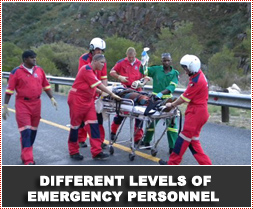
Many young students and scholars have enquired about the different levels of emergency workers they may strive to qualify for. We have been provided by emergency care specialists ER24 with information on these levels. We would like to share this information on the Arrive Alive website:
It is not so many years ago that the function of an ambulance was solely to race to the scene of an incident, pick up the patient and speed off to the hospital, when the sole qualification of the attendant was a drivers license. Simply putting a critically injured patient into the back of a poorly equipped or unequipped vehicle turned out to be the bringing the casualty expertise to the patient was developed and training was introduced at different levels:
a) BASIC AMBULANCE ATTENDANT (BAA): individual who has passed a standardised course that includes the teaching of the following:
This is a Basic Life Support (BLS) certification, and approximately the equivalent of the U.S. EMTB. This is the minimum qualification to be a crew member of an ambulance in South Africa. Training includes a 160 hour course comprising of lectures and practical simulations. The lectures cover basic anatomy and physiology, basic life support (including both CPR and first aid), emergency care, the use of ambulance equipment, including Automatic External Defibrillators (AED), and various medico-legal issues.
The course includes the following:
- Airway Management
- CPR
- Basic trauma life support skills
- Emergency Childbirth
- Basic Extrication skills
- Other non-invasive skills
b) AMBULANCE EMERGENCY ASSISTANT (AEA): individual who has completed a four month course held at a recognised training facility.
This is an Intermediate Life Support (ILS) certification, and generally the equivalent of the U.S. EMT-I, but with some added skills. To apply for this training, candidates must have a minimum of 1,000 hours of practical experience as a BAA and they must pass an entrance exam to be eligible for the course.
As an alternative route to certification, those completing the more advanced tertiary qualifications may challenge the examination and be certified as an AEA after successfully completing their first or second year of training. Training at this level consists of a 470 hour course, comprising of 240 hours of lectures and practical simulations, and 230 hours of experiential learning. AEA’s are qualified to practice various invasive techniques such as IV therapy, needle Cricothyroidotomy and needle Thoracocentesis, as well as Electrocardiogram interpretation, manual external defibrillation, and are allowed to administer various drugs.
The course includes the following:
- Intravenous Fluid Therapy
- ECG interpretation & Defibrillation
- One-Man Intermediate CPR Mega codes
- Selective Drug Therapy – 50% Dextrose & Disprin, Beta two stimulants etc.
- Intermediate Rescue & Extrication Skills
c) CRITICAL CARE ASSISTANT (CCA): individual who has successfully completed a nine month course at the Ambulance Training College’s.
This is an Advanced Life Support (ALS) certification with no NQF. It may be compared to the U.S. AEMT-CC. Candidates must complete a 1,200 hour course to qualify as a CCA. They are qualified to practice a large array of invasive techniques, can perform cardio-version and are allowed to administer narcotics, sedatives and various other drugs.
The course includes the following:
- Cardioversion
- One Man Advanced CPR
- Basic Medical Rescue
- Drug Therapy
- Advanced Airway management
- Advanced ECG interpretation
- Advanced Obstetrical Emergencies & Treatment
d) National Diploma- EMC (N.Dip EMC): individual who has completed a three year course at a Technicon & practical year at a recognised training service. The course includes all of the above mentioned subjects, as well as:
- Advanced Rescue skills
- Ambulance Technology
- Chemistry & Physics
- Advanced Anatomy & Physiology
e). Bachelors of Technology-EMC (B.Tech EMC)- BTech/BEMC or The clinician qualification, is a four year professional degree in Emergency Medical Care (Bachelor Emergency Medical Care), and is placed on the Emergency Care Practitioner (ECP) register @as Independent PracAce@ which has an additional scope of practice. The most notable addition in stand-alone capabilities include Thrombolysis and Rapid sequence induction. ECP’s are also trained in the rescue disciplines offered by their University, normally up to the level of Advanced Rescue Practitioner.
Example: High Angle II- , Motor Vehicle-, Fire Search and Rescue-, Aviation-, Confined Space-, Structural Collapse-, Industrial and Agricultural-, Trench-, Aquatic Rescue, etc. The advantage of the BEMC qualification, is that they can offer their patients a higher quality of care, as they are educated to have a vast amount of emergency medical insight.
The course includes all of the above mentioned subjects, as well as:
- Chemistry & Physics
- Advanced Anatomy & Physiology+
- Advanced Cardiac Life Support and advanced cardiology
- RSI Protocols
f) Emergency Care Technician (ECT) –This mid-level course is of two years duration, and exits on a level just above what many know as Intermediate Life Support (ILS), but below Advanced Life Support (ALS). This course is covered at several training Colleges. They are placed on the Emergency Care Technician (ECT) register.
Also view: